Compose vision.
Create intelligence.
Act in the real world.
GX-Arc turns computer vision from a coding problem into a building problem — drag together a pipeline, or simply describe the task, and ship hardware-optimized production code. Then put that intelligence into robots and machines that do the work.
Two letters. One discipline.
GX is the engine — the way a pipeline is composed, extended and run anywhere. Arc is the intelligence that composes it.
Compose. Create. Act.
Build a pipeline by hand, or describe the task and let Arc build it for you. Then put that intelligence into machines that do the work.
GX-Studio
A drag-and-drop canvas for building IVA and computer-vision pipelines node by node.
GX-Agent
Describe a task in natural language. Arc assembles the same class of pipeline for you.
GX-Robo
Robotics — machines doing work. GX-Robo puts the intelligence into machines.
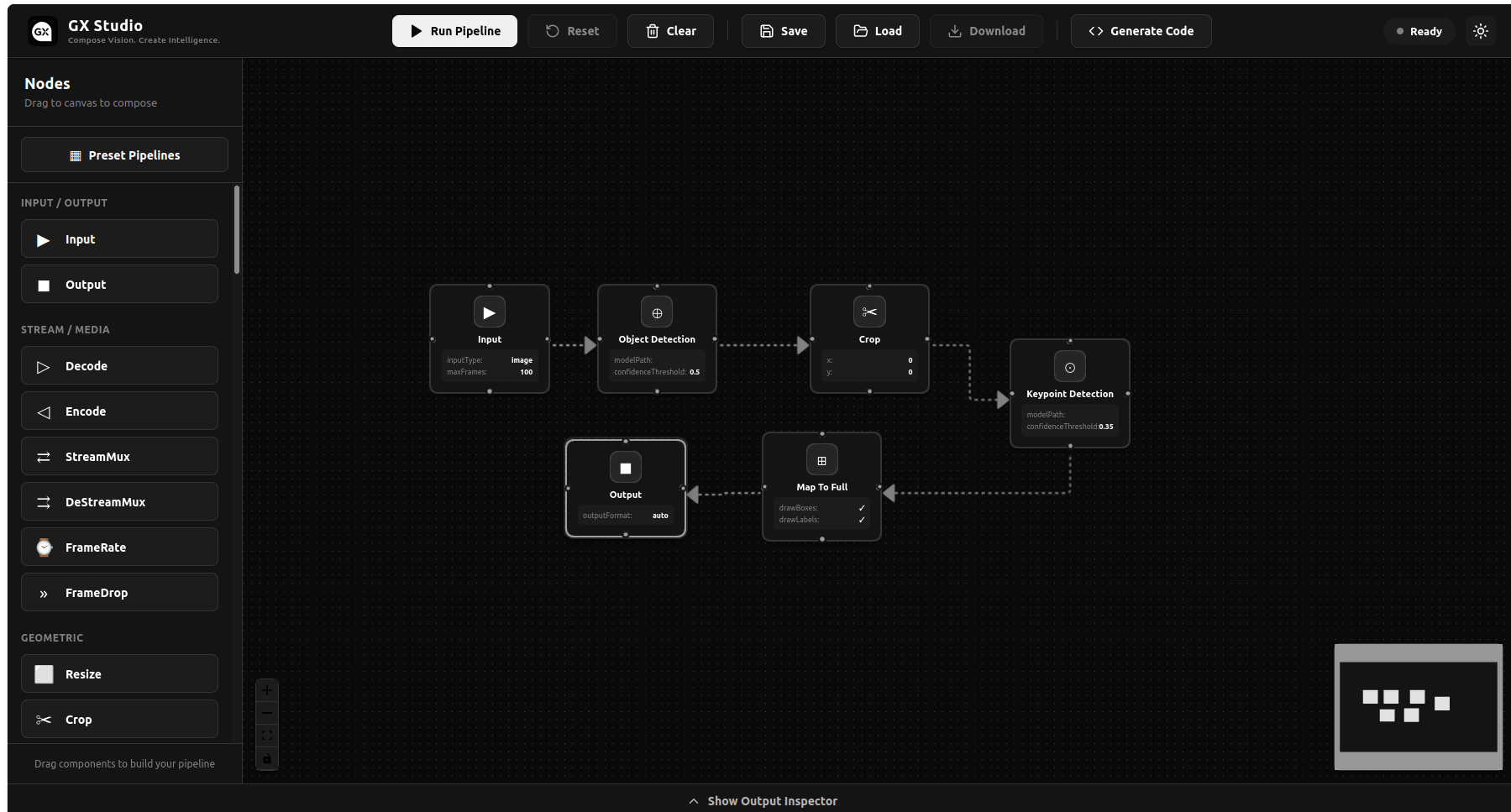
One pipeline, four stages.
What you build in the UI is what ships — inspected, tested, and compiled for the exact hardware it will run on.
Build
Compose the pipeline visually in GX-Studio, or generate it with GX-Agent.
canvasDry run
Select real inputs and models per node, and run the graph live in the UI.
previewGenerate
Emit production-ready code in Python or C++ straight from the graph.
codegenDeploy
Pick the target platform — the output is compiled and tuned for it.
hardware-awareSame pipeline. Any silicon.
One inference pipeline, optimized for the hardware you already have — from Intel CPUs and NVIDIA GPUs to edge NPUs and heterogeneous CPU+accelerator systems.
Edge gateways, industrial PCs, servers, and systems without dedicated accelerators.
Computer vision, video analytics, robotics, and high-throughput AI workloads.
High-performance systems where CPU and GPU resources need to work together efficiently.
Embedded devices, smart cameras, IoT, consumer electronics, and battery-powered systems.
Target selected once, per pipeline — compilation, memory layout and kernel choice adapt automatically.
Your application stays consistent while the execution layer adapts to the silicon — CPU, GPU, NPU, or heterogeneous combinations.
Every AI node needs a model. We keep 21, ready.
A production registry of generic and use-case-specific models, trained in-house on millions of samples — drop any of them straight into a GX-Studio node, or have our team train the one you actually need.
Detection
Locate and classify objects, defects, and events in a frame.
→Segmentation
Pixel-accurate masks for instance and semantic boundaries.
→Classification
Assign labels — product grade, condition, category, state.
→Detect the objects, people, assets, and events that matter to your application.
Understand exactly where an object or region exists — down to the pixel.
Turn visual observations into actionable labels, grades, and decisions.
Keypoints
Pose and landmark estimation for structure-aware tasks.
→OCR
Read text, codes, and serials embedded in the scene.
→Feature extraction
Embeddings for retrieval, re-ID, and similarity search.
→Go beyond detection with precise structural understanding.
Convert real-world text into structured, machine-readable data.
Transform visual content into embeddings for search, matching, retrieval, and re-identification.
No model fits? Our modelling team builds it.
Data engineering, architecture design, and training run by an in-house team of 7+ — for the exact use case, not the closest generic match.